Table of contentsExpand
In the age of AI, the advantage does not go to whoever buys a licence for an advanced agent. It goes to whoever manages the client’s business context well, has a clear strategy and a feel for the market backed by experience. AI does not fix chaos, it just produces mistakes faster. BDOS.ai was not built to replace the specialist on autopilot. It puts the specialist’s operational maturity to a rigorous test.
A tool built by Google Ads practitioners for practitioners
BDOS.ai is an AI assistant for Google Ads and analytics specialists, created by Karol Dziedzic and Krzysztof Bycina. It works directly on ad accounts: it analyses campaigns, points out problems and proposes changes, and it applies each change only after the specialist approves it. The decision always stays with the human.
Behind the architecture: from scripts to the full API and a twentyfold speed-up
The history of marketing tools has come full circle. For years the limit was manual work in the interface. Then came Google Ads Editor and scripts written to automate repetitive tasks. The real shift only gained momentum when modern AI models were connected directly to the Google Ads API, GA4, GTM and the Merchant API, removing the old technical and time barriers.
Here is how the creators of BDOS.ai see this change:
Krzysztof Bycina on the technical breakthrough and working with the API:
The technical side of Google Ads has always been closest to me. That is why working directly on the API, combined with AI agents, feels a bit like a dream come true.
For years I built solutions on Google Ads scripts. They helped in everyday work, but they only cover part of what the API offers.
Two things blocked the move to the API: technology and time. AI removed both barriers.
Today we build a new BDOS feature that genuinely makes a Google Ads specialist’s work easier in a few weeks, sometimes in a few days. For me that is a phenomenal change.
Karol Dziedzic on how the industry has evolved and winning back time for strategy:
It is amazing how much technology can increase the efficiency of Google Ads specialists.
I remember the days of clicking through the interface by hand. Then came Google Ads Editor, followed by scripts and the first automations. Each of those steps saved us hours, but none of them gave full access to the account.
Working directly on the API, combined with AI agents, is the next stage of that evolution. In my experience it gives experts an almost twentyfold speed-up while keeping the same precision.
As a result, we implement strategy, audits and optimisations in real time. We stay ahead of the market technologically and win back time for what matters most in this job: thinking about strategy and building an edge over the competition.
The autopilot temptation in Google Ads: why an AI agent needs a mature process, not another prompt
A senior digital marketer’s day is craft work done under constant distraction. GA4 in one tab, Google Tag Manager in another, Merchant Center, Looker Studio, the client’s Google Ads accounts and a Google Sheets spreadsheet running red hot. Hundreds of metrics, constant analysis of keywords, products and anomalies, and repetitive, mechanical clicking just to pull a simple report or check that an e-commerce event is implemented correctly.
In that environment the promise of AI agents such as BDOS.ai sounds like liberation. Swapping tedious clicking through interfaces for a fluent conversation with your data, and running operations directly through the API, feels like moving from old spreadsheets to a purpose-built operating system.
But a harmful myth quickly appeared on the market: the belief that deploying an AI agent will replace strategy and remove the need for expert knowledge. The opposite is true.
In the AI era the advantage is not built by whoever has access to a faster model, but by an experienced specialist who manages context precisely and keeps a rigorous verification process.
AI as support, not a substitute for mature marketing
The biggest trap when adopting tools like BDOS.ai is treating them as magicians that generate results. AI works as a powerful operational assistant. Put it into a well-organised business with a clear strategy and clean data, and you get a huge advantage. Let it loose in chaos, and the only thing you achieve is producing an even bigger mess at lightning speed.
An AI agent will not come up with a strategy for you. BDOS.ai analyses data from GA4, Google Ads and Merchant Center efficiently, but it only sees numbers and transaction history. It has no access to agreements that are not recorded in the analytics interfaces.
The real value of working with an agent appears when API data meets the specialist’s unique operational knowledge:
- Current business goals: margin changes, planned price increases, logistics constraints and strategic agreements with the client.
- Execution standards: proven optimisation procedures, your own campaign structure templates and agreed rules for writing ad copy.
A local knowledge asset
BDOS.ai runs as a desktop application. The prompts you build, strategic guidelines, project context and access tokens are stored in a local database on the user’s drive. This data does not feed external models, so you can build a personalised knowledge base without the risk of leaking confidential information.
What BDOS.ai really is: an LLM chat vs an operational agent
To understand why working with this tool requires maturity, you need to understand the difference between a regular AI chat and an operational agent.
A traditional chat works in a closed window. You paste in a report and get an analysis, but the whole implementation is on you. The AI suggests, and you have to move everything into Google Ads, GTM or Excel by hand.
BDOS.ai goes a step further and works directly on your systems. It connects through APIs to analytics and advertising tools, using a validation engine, the latest Google Ads API interfaces and integrations with the Merchant API and GA4. The system was built on more than a decade of hands-on experience from Karol and Krzysztof, and it shows in how deeply it understands a specialist’s daily challenges and in the insights it „comes back” with after analysing campaigns. The tool does not just analyse data. It prepares and proposes recommendations on its own, warns against changes that are too aggressive and carries out specific operations.
That kind of agency comes with great responsibility. That is why safe work relies on keeping a human in the loop (Human in the Loop). Nothing happens without your knowledge, and the workflow never changes:
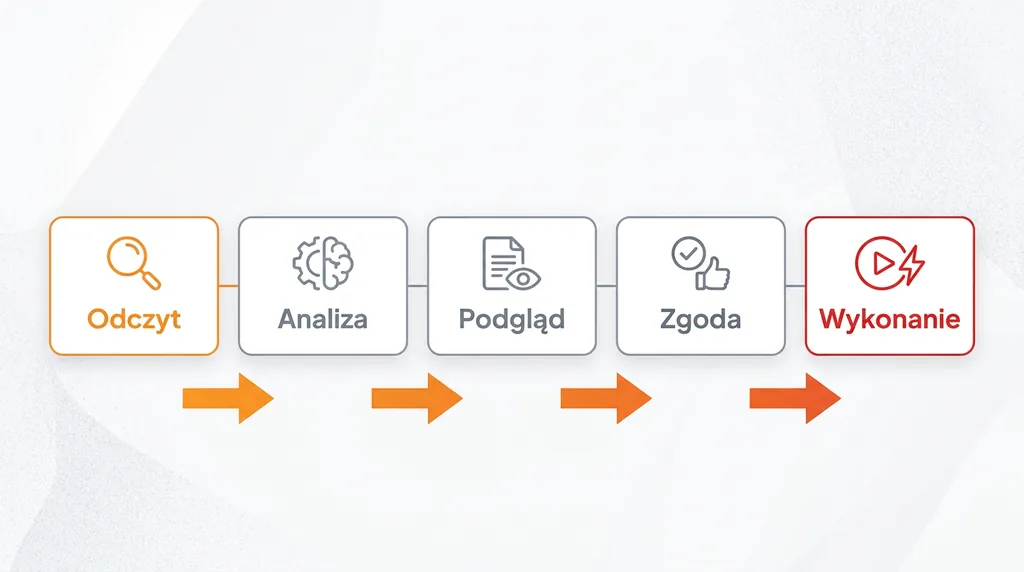
The most important safeguard here is the Dry Run feature, a simulation mode. The agent shows an exact preview of the planned changes before it writes anything to the system. An example? Before attaching a brand exclusion list, you see exactly how many campaigns the decision will affect.
Privacy and data security
A key architectural advantage of BDOS.ai is that it runs locally. The system starts directly on the user’s computer, so authorisation tokens and access credentials for Google Ads, GA4, Merchant Center and GTM do not go to third-party intermediary servers. The creators of the tool do not run their own central dashboard and do not store data from your clients’ ad accounts.
It is still worth keeping the wider data flow in mind. BDOS.ai communicates directly with Google’s infrastructure and with models such as Claude. A specialist deploying the agent should therefore consciously manage how much context is shared and check the data processing terms of the AI model providers themselves.
Case study #1: how safety rigour works in everyday work with Google Tag Manager
On one of the accounts, a conversion tag was sitting in GTM without a trigger assigned, so its data never reached GA4. BDOS.ai diagnosed the error on its own and prepared a ready fix.
Instead of deploying it to the account straight away, it stopped and asked for authorisation. When I replied by sending it a different task, a regular bot could have got confused and treated that as consent. BDOS.ai caught the lack of explicit confirmation, blocked publishing to the production account and asked for a final decision.
The strength of an AI agent is not blind speed, but safety rigour that protects client accounts from accidental changes.
The takeaway? The greatest strength of an AI agent in marketing is not that it can generate a structure in seconds. It is the safety rigour that requires a cool head from the human, a review of the preview and a fully informed decision. What is more, if in the heat of the battle for a better CPA we did not answer clearly whether a change should go live, BDOS.ai comes back with a reminder and asks what to do with the task.
Case study #2: a catalogue of risks. What happens when context and knowledge are missing?
Working with agents in performance marketing does not forgive superficiality. In advertising and analytics systems, a lack of precise context leads straight to wrong budget decisions and wasted spend.
Based on work on real accounts, you can identify seven main classes of risk that every specialist has to deal with:
1. Anatomy of an agent error
If I had to sum up all the slip-ups you can run into when working with an AI agent, the best summary comes from BDOS.ai itself, in our wrap-up analysis (if you use BDOS.ai, just ask it. This is what it told me):
„Almost all of my slip-ups follow one pattern: I fill a gap in the data with my own guess instead of asking or checking, and then I present the guess in the same tone as a fact. Three things caught it: your live tests, the mandatory preview before every change, and the fact that you tell me straight when something is wrong.”
Only three things stop an error like that from reaching production: live tests, a mandatory preview of changes and uncompromising verification.
2. Hallucinated values and no verification at the source
A language model can give numbers or currencies based on a guess instead of checking them firmly through the API or on the client’s website.
- A real example: while preparing a dataLayer configuration, BDOS.ai put made-up amounts in EUR into the code. It ignored the fact that the site being analysed showed official service prices in PLN.
- The consequence: the generated code contained wrong currency and price data. Had it reached production without verification, it would have distorted e-commerce analytics and sent false conversion values to GA4 and Google Ads.
- The lesson: no agent is error-free. This case shows why the human-in-the-loop principle is absolutely essential: the specialist’s job is to catch hallucinations like this before they are deployed.
3. API semantics vs reality
Mistakes caused by interpreting variant API fields or complex data structures as separate business objects.
- A real example: while reading links from the API, the agent interpreted different types of links and associations in a single variant field as three separate Google Merchant Center accounts, and built a proposed action plan on that wrong assumption.
- The consequence: building complex remediation strategies for problems that do not physically exist in the client’s infrastructure.
4. No time context or history (alerts without a baseline)
Drawing conclusions from the current state or from hidden conversions without taking the timeline and the campaign start date into account.
- A real example: hunting for a conversion tracking failure, or building an in-depth performance analysis, on a fresh account that was launched the day before and has not yet collected a large enough data sample.
- The analytics lesson: proper monitoring (for example GA4 alerts) cannot rely on simple thresholds based on yesterday. It has to compare data against the median for the same weekdays over a longer period (for example 2 to 4 weeks) and clearly separate a drop in market demand from a measurement failure (when site traffic stays normal but key events drop to zero).
5. Lost context of unwritten agreements (Consent Mode and exclusions)
Ignoring business and legal rules that are not written directly into campaign settings, but come from agreements with the specialist or from GDPR and ePrivacy requirements.
- A real example: counting phone calls as primary conversion goals again, or deploying tracking tags in GTM without checking them against the closed list of Consent Mode v2 signals.
- The consequence: a tag added without proper consent will either never be authorised, or it will breach users’ privacy and the consistency of conversion modelling.
6. The guessing loop and mixing up objects
The moment when the agent carries conclusions or tasks over between different client accounts, and its unspoken hypothesis starts to sound to the user like a verified fact.
- A real example: mixing up the budget context of different projects in one summary report, and presenting a made-up guess in the same confident tone as a verified fact from the API.
- The consequence: hard analytics gets replaced by an illusion of correctness, with the risk of making the wrong decision on the wrong account.
7. Leaky data sources and the illusion of a „clean dashboard” (iOS vs Android)
An error that comes from treating Google Ads or GA4 reports as the single source of truth about the business, while mobile ecosystems deliberately limit or delay attribution signals.
- A real-life scenario: you are promoting a mobile app. The ad leads to the App Store, where the user installs the app and makes a purchase of 500 PLN two days later. On iOS (because of Apple’s ATT restrictions and the SKAdNetwork / AdAttributionKit mechanisms), the direct link between the ad click and that purchase is erased or reported with a delay of several days in aggregated form. On Android, on the other hand, data flows in real time thanks to GAID identifiers and native integration with Google Play.
- The consequence for the AI: after analysing the last 48 hours of data from the interface, BDOS.ai will see a dramatic drop in ROAS and zero conversions on the iOS campaign. Following its mathematical logic, it will immediately recommend: „The iOS campaign is unprofitable, pause it or cut its budget by 80% in favour of Android”.
- Why can’t the AI handle this? BDOS.ai works on the data it received through the API. It cannot conjure up events that Apple never sent to the ad platform. It has no view of what happened in your internal backend (CRM, databases, payment systems) unless a dedicated attribution architecture has been built there.
AI as the compass, not the captain: the senior’s role and decisions the algorithm cannot understand
The iOS and Android app campaign example shows perfectly where the hard limit of AI lies and why effective performance marketing needs a mature specialist.
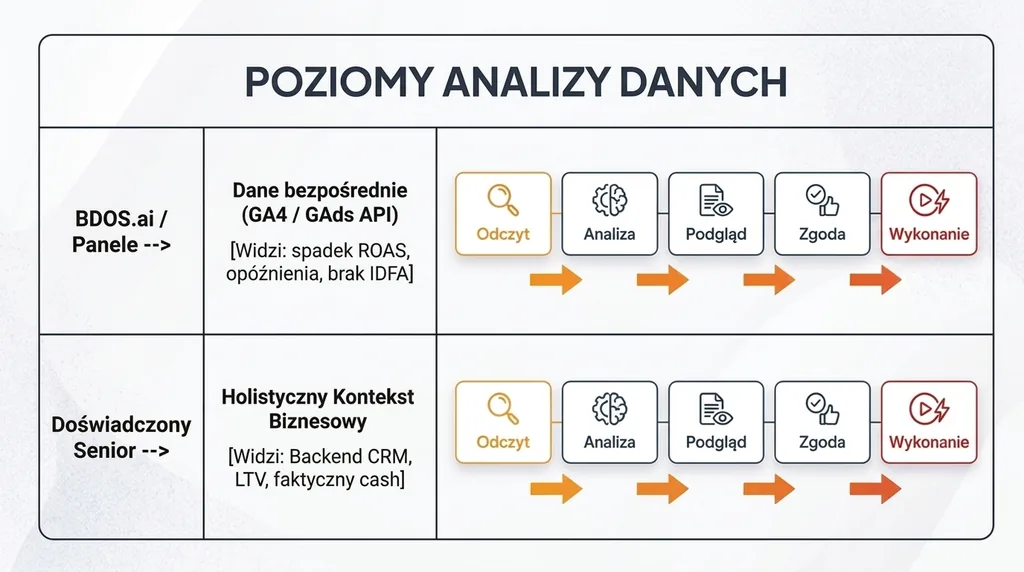
An AI system draws conclusions only from what it sees in Google Ads, GA4 or Merchant Center. Meanwhile an experienced senior knows that to make sound business decisions, they have to look far beyond those interfaces.
Why key decisions are made outside the ad platform
A strategist’s job today is to verify the backend and hold the „advertising signals” up against the revenue in the company’s bank account. A human understands what the algorithm cannot infer from limited data:
- The real value in the backend: they know that an iOS campaign which looks unprofitable in Google Ads actually brings in the most valuable users with the highest LTV (lifetime value) in the backend.
- Accepting delays: they understand that missing iOS conversions from the last few days are not a failure but a deliberate protective delay from Apple (privacy delay), and instead of pausing or limiting the campaign, they check the overall jump in sign-ups in the backend.
- Telling platforms apart: they know the technical regimes of iOS and Android, and that Android’s better result in the dashboard can be misleading because it comes from easier attribution, not higher traffic quality.
Why a human’s recommendations may make no sense to BDOS.ai
This creates a fascinating paradox in everyday work with an AI agent. When an experienced specialist decides to increase the budget of a campaign that seems to have a terrible ROAS in the ad platform, BDOS.ai may consider it irrational, or even an operator error.
Asked to analyse that move, the AI agent will answer: „This change contradicts optimisation principles”. Why? Because it lacks the business context that is not in the API. BDOS.ai does not know that the specialist has just checked the account, added up backend revenue, looked deep into the available data and connected dots the ad system could not connect.
No algorithm knows on its own:
- Whether a drop in ROAS comes from poor optimisation or from a deliberate clearance sale.
- Whether a higher cost per lead (CPA) is acceptable because a new product line has a higher margin.
- What is behind the arrangements with suppliers and what the company’s current logistics constraints are.
The real value of a human lies in finding untapped areas, making bold hypotheses and designing experiments the algorithm would simply never think of. We are the ones who bring unconventional thinking to marketing: from repositioning and looking for new angles in the narrative, to deliberate management of Merchant Center data and designing multi-stage funnels in Demand Gen.
An AI system (such as BDOS.ai) does the grunt work for us: it aggregates data, spots anomalies in seconds and removes routine clicking from our working day. But the specialist is the captain who interprets the signals, checks them against business reality and takes full responsibility for where the whole machine is heading.
My B-D-O-S-AI model: are you ready for an agent?
Before you decide to bring an AI agent into your daily work with Google Ads or GA4, check how ready your organisation is with a simple decision framework:
| Element | Checkpoint question | Example in Google Ads / analytics |
| B: Business problem | What specific, recurring process problem are we solving? | Cutting an audit, anomaly monitoring or building a PMax / Demand Gen campaign from 4 hours to 45 minutes without losing quality. |
| D: Data | Are the analytics, the account and the data sources clean and reliable? | Verified e-commerce events in GTM with Consent Mode v2 support, a checked feed in the Merchant API, a known campaign start date and a connected business backend. |
| O: Operating process | Do you have a written checklist, procedures and validation rules? | A mandatory preview step (Dry Run), live event tests and a rule of explicit authorisation before any change is saved. |
| S: Strategy | Does using the tool support your main growth lever? | Focusing the specialist’s time on non-obvious hypotheses, backend analysis and margin optimisation, not on clicking through interfaces. |
| AI: Experiment and scale | Do you start with a small test and measure the results? | Rolling the agent out on one account, reviewing the mistakes it makes, building a private library of procedures or skills, and only then scaling. |
Through practitioners’ eyes: how BDOS.ai changes the specialist’s role
Theory about the potential of AI agents only gains real value when you hold it up against the experience of experts who manage budgets and client accounts every day. Their perspective is clear: the change is not about replacing people, but about redefining what the client actually pays for.
Marcin Wsół on shifting the weight of the work:
From my perspective, the biggest value of tools like BDOS.ai is not that they can make decisions for the specialist, but that they significantly shorten the path from a question to the data needed to make that decision. In everyday Google Ads work, a large share of the time goes not into the analysis itself, but into getting to the right data, putting it together and doing many repetitive tasks. If an agent can do that part in a few seconds, the specialist can spend more time interpreting results, on strategy and on finding the reasons behind what is happening in the account.
At the same time, as these tools become more capable, the experience of the person using them matters more. The easier it is to make a change in the account, the more important the question becomes: not „can we do it?”, but „should we do it?”. And this is exactly where knowledge of the client’s business, the account history and the specialist’s experience still matter enormously 🙂
In practice, AI does not so much eliminate the Google Ads specialist’s role as shift its weight from operating the interface towards interpreting data, strategy and controlling automation.
Artur Smolicki on the new standard of analysis and looking for growth:
For years, a Google Ads specialist’s job was mostly associated with clicking in the interface: changing a bid, adding exclusions, switching the strategy. That has long stopped being enough. The client does not pay for clicking, but for finding conversions, sales and leads where others are not looking for them. And that is where BDOS.ai has changed my work the most.
With BDOS.ai I can analyse data much more deeply than time allowed when working by hand. I can put campaign results side by side with GA4 data, the Merchant Center feed and the GTM configuration, compare them over a longer period and test hypotheses I simply did not have the hours for in a week. Which products have potential but do not get budget? On which search terms is the client losing sales? Instead of asking myself these questions once a quarter, I can come back to them regularly on every account.
For the client this makes a real difference. They no longer get a specialist who makes sure the campaigns „keep running”. They get someone who actively looks for additional conversions: in the data, in the account structure, in the product feed, and even in whether the measurement itself is correct. BDOS.ai takes over collecting and combining data, and I can focus on what it means for the business. That is how I understand the specialist’s role today: less operating the interface, more analysis, conclusions and responsibility for the client’s results.
BDOS takes on all the tedious work we did by hand until recently. Creating dozens, if not hundreds, of ad groups with highly personalised copy is now a possibility that translates into real business results. Analysing tens of thousands of search terms and categorising them by purchase potential or performance gives me a powerful base for my own analysis. Combining the data BDOS generates with other analytics tools gives an unprecedented level of detail and room for optimisation.
Summary: the new standard of working in Google Ads
BDOS.ai and similar operational agents have not arrived to take work away from experienced marketers. Their arrival simply sets a new, higher standard of maturity in campaign management.
Market experts speak with one voice: the weight of the specialist’s role is shifting irreversibly from mechanically operating the interface towards in-depth analytics, building strategy and responsibility for the business result. When collecting data, surfacing anomalies or building structures takes an agent a few seconds, the key skill becomes asking the right questions and interpreting the answers.
The real competitive advantage today is not built by whoever has access to the fastest AI model, but by whoever can feed it precise context, keep the data clean and stay in full control of how every decision is executed.
FAQ
Frequently asked questions
No. BDOS.ai works on the human-in-the-loop principle. The system uses a simulation mode (Dry Run), which means it shows an exact preview of planned changes before carrying out any operation. Without your clear and explicit authorisation, no modification is saved to a live account in Google Ads, GTM or Merchant Center.

About the author
Radosław Mentel
Certified Google Partner (Ads & Analytics) with over 17 years of experience. For years, I've taught marketing at SGH and judged the best campaigns in Poland as a semKRK Awards judge.
More about me