Table of contentsExpand
If you have even one campaign running Target CPA or Target ROAS that has ever shown up as „limited by budget” (the red status, not the yellow one, more on that below), open its bid strategy settings today and check whether its recent actual result was better than the target you declared. If it was, since August 17, 2026 that result has started drifting toward the target, which means it’s getting worse in practice. Nothing is broken. Google simply started taking your target literally.
Before you do anything else, do this one thing: use Google’s bid target adjustment tool (available in the panel since July 6, 2026) on every such campaign and decide consciously what to do with the target. The options and the exact direction to move each metric, CPA versus ROAS, are explained below, because it is not symmetrical.
What actually changed
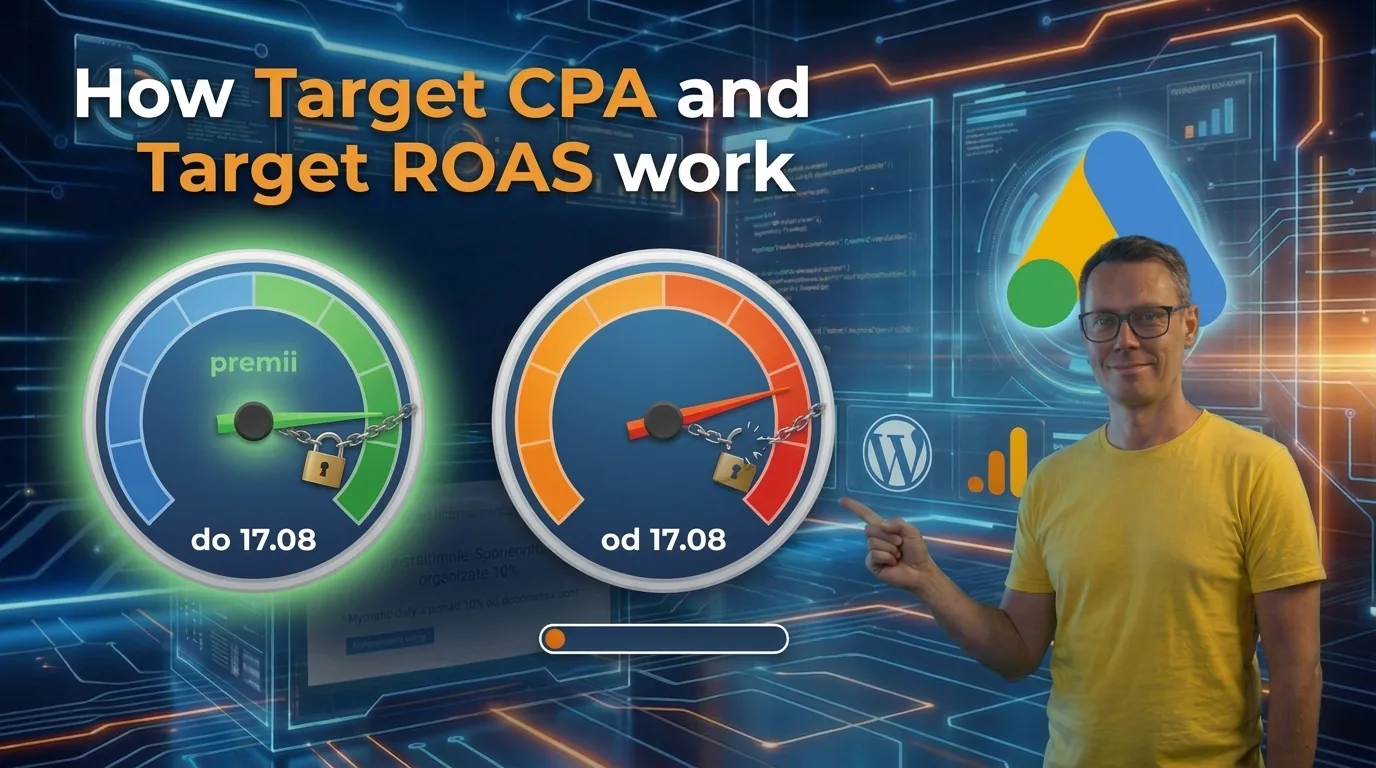
Since August 17, 2026, campaigns running Target CPA or Target ROAS that are marked as limited by budget stopped beating their target. Google gives its own example: a campaign with a Target CPA of $10 that had actually been converting at $5 will start moving toward that $10. It will not stay at the more favorable number.
The change covers Search, Shopping, Performance Max, Display, plus Hotel and Travel campaigns, and for Demand Gen it also covers Target CPC. One caveat for Demand Gen: Smart Bidding there relies mainly on conversion or lead value, so the budget mechanism described here applies primarily to classic Target CPA and Target ROAS. Treat the Demand Gen part as secondary.
Why budget-limited campaigns overpay in the first place
This was not a bug or a hidden feature. It is a side effect of how a campaign ends up limited by budget when running a target-based strategy at all. The mechanism is simpler than it sounds.
A campaign lands in „limited by budget” status when its target is set too unambitious: a Target CPA that is too high, or a Target ROAS that is too low. A loose target signals to the algorithm that it can bid aggressively, because it can „afford” expensive conversions. The result: bids in the auction climb, the daily budget runs out before the day ends, and the campaign gets the red „limited by budget” badge.
Until August 17, this had a paradoxical upside. Since the budget ran out early anyway, the algorithm never fully caught up to the loose target it was given, so the actual result often came out better than the campaign had promised itself. That was the „bonus.” Google is now closing that gap on purpose. The system is meant to move more consistently toward the stated target, even as the budget shrinks.
Two kinds of „limited by budget,” and only one applies to you now
This distinction trips a lot of people up, and it matters:
- 🟡 The yellow or orange warning shows up on „Maximize” strategies, such as Maximize Conversions. In practice it is a suggestion: „you could get more if you raised your budget.” There is usually no reason to panic here. It is the normal state for these strategies, not something that needs fixing right away.
- 🔴 The red warning shows up on target-based strategies: Target CPA, Target ROAS. It means the budget is physically too small to last through the day, so ads drop out of the auction before the day is over. These are the campaigns the August 17 change actually affects.
If your campaign shows yellow, this change probably does not affect it directly. If it shows red and runs on a target, check it first.
How to adjust your targets correctly, and why direction matters
This is where it is easiest to get confused, because Target CPA and Target ROAS respond to a change in the number in opposite directions. A „lower number” does not always mean a „looser target”:
- Target CPA: lower the number to tighten the target. For example from $50 to $30. A tighter target lowers bids in the auction → the daily budget lasts longer → the same budget yields more conversions, not fewer.
- Target ROAS: raise the number to tighten the target. For example from 400% to 500%. A higher required return makes the algorithm bid more conservatively, which improves profitability.
- An alternative for either metric: if you want to keep your current, favorable cost per conversion but scale up volume, raise the daily budget instead of touching the target.
In the bid target adjustment tool (available in the panel since July 6, 2026) you get three options for each campaign:
- Keep the current target. This only makes sense if it genuinely reflects the cost or return you want to pay. For accounts that had been enjoying the „bonus,” this means consciously accepting a worse result.
- Match the target to recent performance. The tool proposes a value based on historical results: for Target CPA it lowers the amount to the actual recent cost per conversion (say, from $10 to $5), and for Target ROAS it raises the percentage to the actual recent return (say, from 400% to 800%). Both changes recreate the favorable efficiency you already had.
- Set a custom target manually, if neither of the two ready-made options fits.
Notifications about the tool go to accounts that had at least one budget-limited, target-based campaign at any point in the last 12 months.
What is already showing up in practice
On September 15, 2026, Search Engine Roundtable covered early data on the change, citing analysis from Mike Ryan at Smarter Ecommerce along with commentary from Kirk Williams. A consistent pattern emerges: campaigns still running loose targets started paying more per click, because Google stopped artificially suppressing their bids to stay under budget. That suppression used to mean these campaigns were mostly competing on CPC alone. After the change, that situation is starting to reverse. At the same time, some campaigns without a budget limit started paying less for the same auctions and winning positions that used to be out of reach on rank, because a pool of cheaper clicks that budget-limited campaigns used to soak up got freed up.
The authors do not give specific figures in the text. The data is shown as charts only, so treat this as a confirmed direction, not a ready-made benchmark to compare your own account against. Check your own numbers: compare CPC and lost impression share from July and from September in your budget-limited campaigns, separately for those on a target and those without one.
Before you tighten a target: two diagnostic traps
- Conversions are counted on the click date, not the conversion date. The current number will „grow” over time as users who interacted with the ad earlier go on to convert. A campaign might already be hitting its target and you just cannot see it in the report yet. It’s the same conversion-window mechanic I cover in why conversions in GA4 and Google Ads differ.
- Check the target’s change history before deciding something is broken. The strategy settings show whether and when the target was last changed, and what the average target was over the period you are looking at. Sometimes it turns out the campaign has actually been delivering what you asked for.
Once you are confident about the real result, split it into two different cases, because the right move is the opposite in each:
- The actual result was better than the target → tighten the target (CPA down, ROAS up), so you stop overpaying for artificially inflated bids you never actually needed.
- The actual result was worse than the target, and the campaign is budget-limited → that is a sign the target is too ambitious for the campaign’s current bidding or conversion capacity. Tightening it further, for example lowering CPA even more, will only slow the bidding down and cut volume. Instead of squeezing the algorithm harder, loosen the target or work on conversion rate and budget, and wait for the campaign to start hitting what you are actually asking of it.
What to do: a checklist
- Find every campaign on Target CPA or Target ROAS that has ever shown the red „limited by budget” status.
- For each one, check the actual result from the last 30 days against the declared target.
- If the result was better than the target, decide consciously: keep the target and accept the worse result, or tighten it through the panel tool (CPA down, ROAS up).
- If you want more volume while keeping the current efficiency, raise the daily budget instead of touching the target.
- If the campaign is profitable and you have room in the budget, just raise the daily budget and leave the target alone instead of tightening it. You clear the red alert, keep your volume, and avoid the CPC increase that tightening would cause.
- Do not tighten a target on a campaign that was already missing it, until you have checked the change history and accounted for conversion reporting lag. If it genuinely is not hitting the target despite the budget limit, consider loosening it instead of tightening further.
- Compare CPC and lost impression share (due to budget and due to rank) before and after August 17, using your own data, not someone else’s chart.
If you go through this checklist and you are still not sure whether your account has this set up correctly, reviewing targets and bid strategies like this is a standard part of a Google Ads audit.
FAQ
FAQ
Yes. The change also applies to Performance Max campaigns running Target CPA or Target ROAS, if they are budget-limited.
Sources
- Early Data On Google Ads August 17 Bidding Update (Search Engine Roundtable, September 15, 2026)
- Changes to target based bid strategies (Google Ads Help)
- Frequently asked questions about changes to Target-based bid strategies (Google Ads Help)
- Google Ads Ended Target Overperformance on August 17, 2026 (Miraflow)
- Google Ads Target Bid Strategy Changes: What Changed in August 2026 (PPC Hero)
- Google’s August 17 Bidding Change: What Advertisers Need to Do Now (Optmyzr)
- Google Ads Changes With Bidding For Campaigns Limited By Budget (Search Engine Roundtable)
- Google Ads Bid Target Adjustment Tool: The August 17 Bidding Change, Decoded (Rolloutbrief)
- Is Google Ads Fighting You? 5 „Limited” Warnings Explained (Jyll)

About the author
Radosław Mentel
Certified Google Partner (Ads & Analytics) with over 17 years of experience. For years, I've taught marketing at SGH and judged the best campaigns in Poland as a semKRK Awards judge.
More about me